
VIA Rail Carry-On & Checked Baggage Policy 2026
VIA Rail Carry-On & Checked Baggage Policy
Travelling with VIA Rail is one of the most convenient ways to explore Canada, whether you’re travelling between major cities in the Québec City–Windsor Corridor or embarking on a cross-country journey aboard The Canadian. Before your trip begins, understanding VIA Rail’s baggage policy can help you avoid unexpected fees, packing problems, or delays at the station.
VIA Rail has established baggage rules that balance passenger comfort, onboard safety, and available storage space. The baggage allowance you receive depends on several factors, including your travel route, fare class, train service, and the stations included in your itinerary. Some trains provide both carry-on and checked baggage services, while others only allow passengers to bring carry-on luggage.
This guide combines all of VIA Rail’s official baggage policies into one easy-to-follow resource. Whether you’re travelling with standard luggage, oversized baggage, medical equipment, bicycles, musical instruments, sports gear, or travelling with infants, you’ll find everything you need to know before arriving at the station.
VIA Rail Baggage Policy Overview
VIA Rail divides baggage into two main categories:
| Baggage Type | Description |
|---|---|
| Carry-on Baggage | Items passengers bring onboard and keep with them during the journey. |
| Checked Baggage | Larger luggage that is checked before departure and stored separately until arrival. |
Not every VIA Rail route offers checked baggage service. Many Corridor trains only permit carry-on baggage, while selected long-distance trains offer checked baggage depending on station facilities.
Passengers should always verify baggage availability before travelling because services can differ depending on:
- Train route
- Departure station
- Arrival station
- Fare purchased
- Train equipment
- Seasonal operational changes
Important VIA Rail Baggage Rules
Before packing, passengers should remember several key rules.
- Every passenger is responsible for their own baggage.
- Carry-on baggage must fit within designated onboard storage areas.
- Checked baggage is only accepted at participating stations.
- Bags exceeding weight or size limits may be refused.
- Certain dangerous or prohibited items are never accepted.
- Bags should always be properly labelled with passenger information.
- VIA Rail recommends arriving early when checking baggage.
- Storage space onboard is limited and available on a first-come basis.
Carry-On Baggage
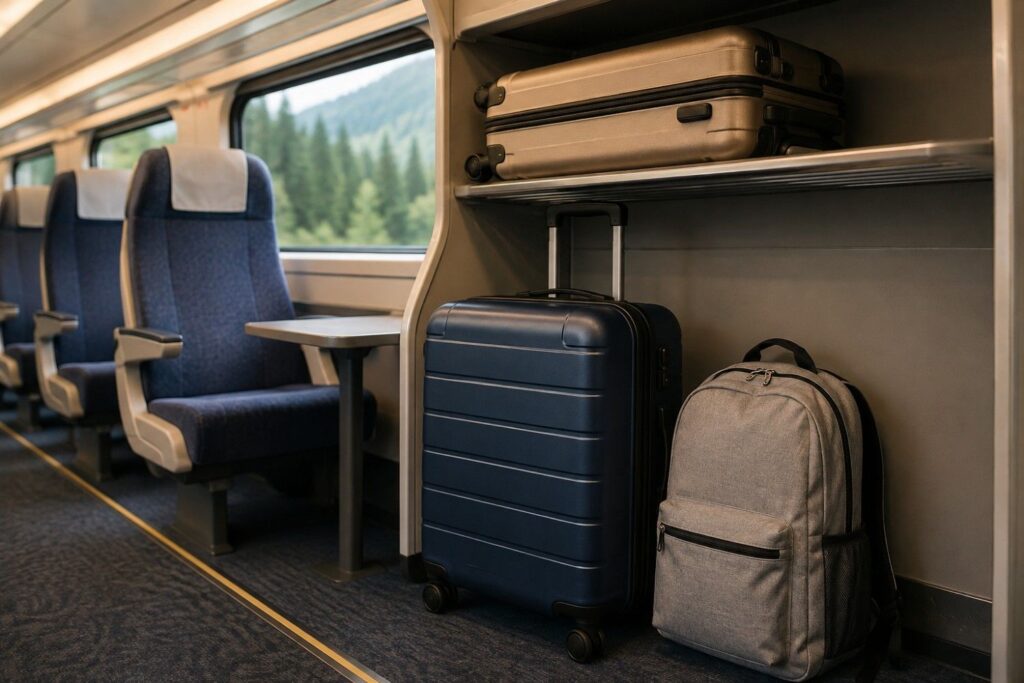
Carry-on baggage refers to luggage that remains with the passenger throughout the journey. These items are stored in luggage racks, overhead shelves, or designated storage areas inside the train.
Carry-on baggage is the most common baggage option on VIA Rail services, especially throughout the Québec City–Windsor Corridor where checked baggage may not be available.
Passengers should ensure that every item can be safely lifted without assistance and stored securely without blocking aisles, exits, or emergency equipment.
Examples of common carry-on baggage include:
- Suitcases
- Duffel bags
- Small backpacks
- Laptop bags
- Handbags
- Camera bags
- Briefcases
- Small travel bags
Carry-On Baggage Allowance
Carry-on allowance varies depending on the fare purchased.
Generally, passengers may travel with a combination of personal items and larger carry-on luggage provided the total number, dimensions, and weight comply with VIA Rail’s baggage rules.
Personal items may include:
- Purse
- Laptop bag
- Small backpack
- Camera case
- Briefcase
- Small handbag
Larger carry-on luggage includes standard cabin-size suitcases or travel bags.
Carry-On Size Requirements
Carry-on baggage must fit within VIA Rail’s permitted dimensions.
| Item | Requirement |
|---|---|
| Personal item | Small enough to fit under the seat or designated area |
| Carry-on suitcase | Must remain within VIA Rail’s permitted dimensions |
| Storage | Must fit safely in luggage racks or overhead storage |
| Passenger responsibility | Must be carried and lifted by the passenger |
If baggage exceeds permitted dimensions, VIA Rail may require it to be checked (where available) or refuse transportation.
Weight Requirements
Weight restrictions help ensure passenger safety and prevent injuries during loading.
Passengers should be able to:
- Lift baggage independently
- Place luggage into overhead racks
- Remove baggage safely
- Avoid blocking passageways
Extremely heavy carry-on baggage may not be accepted even if it meets dimensional requirements.
Where Carry-On Bags Are Stored
During travel, passengers may store carry-on baggage in several onboard locations depending on train type.
Storage locations include:
- Overhead luggage racks
- End-of-car luggage racks
- Under-seat storage (small items)
- Dedicated luggage storage areas
Passengers should never leave baggage in:
- Aisles
- Doorways
- Emergency exits
- Wheelchair spaces
- Vestibules
Keeping baggage properly stored improves safety and allows crew members to move freely throughout the train.
Tips for Carry-On Travellers
Packing efficiently can make boarding much easier.
Recommended practices include:
- Label every bag clearly.
- Keep valuables with you.
- Carry medications separately.
- Pack chargers in an accessible location.
- Secure laptops and electronics.
- Avoid overpacking.
- Keep travel documents easily accessible.
- Use durable luggage with working wheels.
Checked Baggage
Checked baggage is designed for passengers travelling with larger suitcases that cannot comfortably be carried onboard.
When checked baggage service is available, passengers hand their luggage to VIA Rail staff before departure. The baggage is then transported separately and collected after arrival at the destination station.
Not every station provides checked baggage service.
Passengers should verify both:
- Departure station
- Destination station
before assuming checked baggage is available.
When Checked Baggage Is Available
Checked baggage is generally available only on selected long-distance routes and participating stations equipped with baggage handling facilities.
Availability depends on:
- Train service
- Route
- Station facilities
- Operational requirements
Some Corridor stations do not offer checked baggage even if larger stations on the route do.
Benefits of Checking Your Baggage
Many passengers choose checked baggage because it provides several advantages.
Benefits include:
- Less luggage onboard
- Easier boarding
- More seating comfort
- Reduced lifting
- Better mobility during travel
- Convenient transport for large suitcases
Preparing Checked Baggage
Before arriving at the station:
- Attach identification tags.
- Lock luggage securely if desired.
- Remove fragile valuables.
- Keep medications with you.
- Carry passports and important documents separately.
- Do not pack prohibited items.
- Arrive early to allow enough time for baggage processing.
Checked Baggage Size and Weight
Checked baggage must meet VIA Rail’s permitted size and weight requirements.
Oversized or overweight baggage may:
- require additional fees,
- be refused,
- require special arrangements,
- or need alternative transportation.
Passengers should weigh luggage before leaving home to avoid delays.
Carry-On vs Checked Baggage
| Feature | Carry-On | Checked |
|---|---|---|
| Travels with passenger | Yes | No |
| Stored onboard | Yes | No |
| Collected after arrival | No | Yes |
| Available on every train | Mostly Yes | Selected routes only |
| Passenger access during trip | Yes | No |
| Suitable for valuables | Yes | No |
Baggage Allowance Depends on Your Fare
The baggage allowance may differ depending on your fare category and travel class.
Factors that can affect your allowance include:
- Economy Class
- Business Class
- Sleeper Plus
- Prestige Class
- Long-distance services
- Corridor services
- Promotional fares
Higher service classes often include more generous baggage allowances than discounted fares, although all baggage remains subject to VIA Rail’s operational limits.
General Baggage Summary
| Category | Summary |
|---|---|
| Carry-on baggage | Available on most VIA Rail services |
| Checked baggage | Available only on eligible routes and stations |
| Personal items | Permitted within baggage allowance |
| Oversized baggage | May require special handling |
| Dangerous goods | Not permitted |
| Medical devices | Accepted under specific conditions |
| Sports equipment | Subject to equipment-specific rules |
| Musical instruments | Permitted under applicable size requirements |
| Infant equipment | Certain essential items accepted |
| Passenger responsibility | Proper packing and identification required |